Shared vs Cloud Hosting Is About Capability
You are choosing website hosting for your small business.
The options seem overwhelming.
Shared hosting is cheaper than Cloud hosting.
The price difference seems significant.
But here is what that price comparison misses: shared vs cloud hosting is NOT about cost.
It is about capability.
Shared hosting and cloud hosting operate on fundamentally different infrastructure models.
Those differences determine whether your website becomes a reliable business asset or a liability waiting to fail at the worst possible moment.
Understanding the Basics: Shared vs Cloud Hosting Explained
Before comparing shared vs cloud hosting, you need to understand how each actually works.
What Is Shared Hosting?
Shared hosting places your website on a server alongside dozens or hundreds of other websites.
Think of shared hosting like renting a desk in a busy co-working space.
You get access to the building and basic facilities, but you share resources with everyone else. When the space gets crowded, everything slows down. When one person causes problems, everyone suffers.
Shared hosting providers can offer low prices because they pack hundreds of websites onto each server, spreading infrastructure costs across many customers.
What Is Cloud Hosting?
Cloud hosting uses a network of interconnected servers rather than one physical machine.
Think of cloud hosting like operating from multiple interconnected locations with automatic backup.
Your website is distributed across multiple servers simultaneously.
If one server fails, others instantly take over.
When traffic increases, resources scale automatically.
Cloud hosting costs more because you are paying for infrastructure redundancy, guaranteed resources, and automatic scaling capability.
SO WHAT? Why Your Hosting Choice Matters for Your Business
Most UK small businesses choose website hosting based purely on the monthly price.
They see the price difference and choose the cheaper option without understanding what that price difference actually represents.
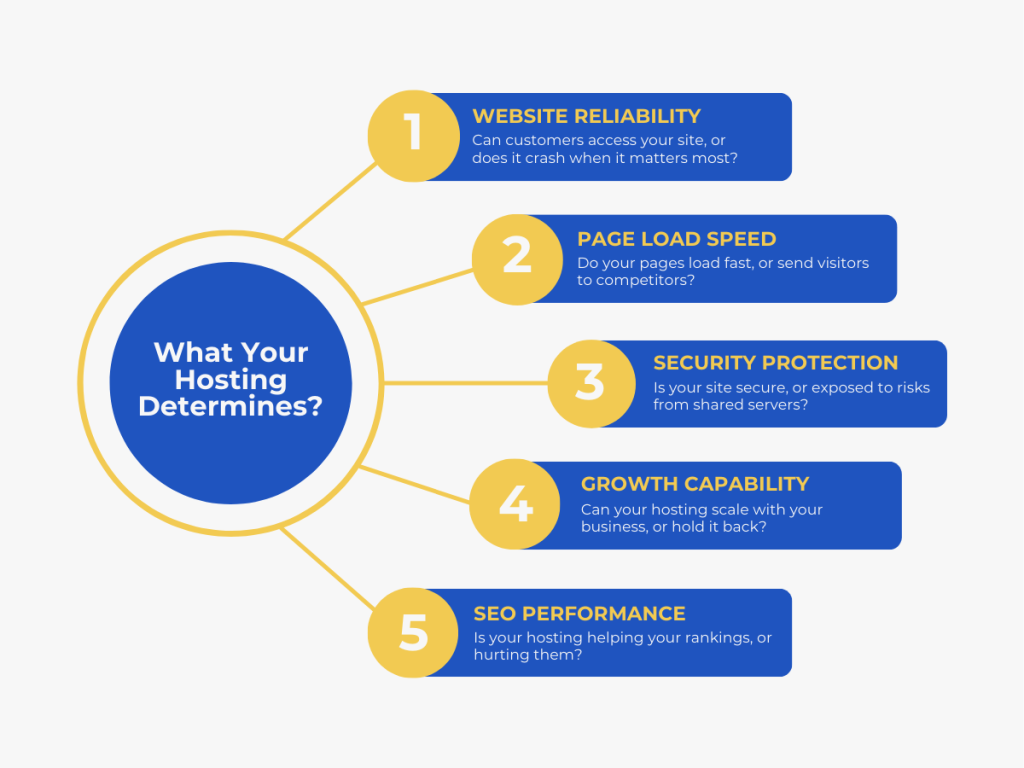
For businesses where websites generate leads, process sales, or build credibility, your hosting choice directly impacts revenue and growth capability.
The question is not “which costs less monthly?”, it is “which one protects my business and enables growth?”
Shared vs Cloud Hosting: The Performance Comparison
Let’s examine how shared hosting performance compares to cloud hosting in real business scenarios.
Normal Traffic Conditions
Shared Hosting Performance: Your site might load acceptably during off-peak hours, but performance depends entirely on what the other 100+ websites on your server are doing. If any neighbour site experiences traffic spikes, your performance degrades.
Cloud Hosting Performance: Your site loads consistently because you have dedicated resources. Other websites cannot impact your performance. Load times remain stable whether you have 10 visitors or 1,000 visitors.
The Winner: Cloud hosting delivers continuous consistency compared to shared hosting that delivers variability you cannot control.
Traffic Spikes and Marketing Success
Shared Hosting Performance: Your marketing campaign drives more traffic than normal. Your social media post goes viral. Your SEO finally delivers results. But your shared server cannot handle the load, causing your site to slow dramatically or crash entirely.
Cloud Hosting Performance: Increased traffic triggers automatic resource scaling. Your infrastructure expands to match demand instantly. Your site handles surges smoothly.
The Winner: Cloud hosting enables marketing success compared to shared hosting, which punishes it.
Seasonal Business Peaks
Shared Hosting Performance: Your business experiences seasonal peaks, but your shared hosting struggles during the exact periods your business needs performance most. Customers lose patience, and you lose sales during critical revenue periods.
Cloud Hosting Performance: Resources automatically scale during peak periods. Customers complete transactions regardless of how many people are buying simultaneously. Peak seasons become peak revenue instead of infrastructure crises.
The Winner: Cloud hosting handles seasonal businesses effectively compared to shared hosting, which struggles when you need it most.
Long-Term Reliability
Shared Hosting Reliability: If the physical server experiences a hardware failure, every website goes down simultaneously until repairs are completed. If one website gets hacked, every site on the server faces risk.
Cloud Hosting Reliability: Your website exists across multiple servers. Hardware failures in one area do not affect your availability. Security issues with other sites do not compromise yours.
The Winner: Cloud hosting provides reliability through redundancy compared to shared hosting, which creates single points of failure.
Shared vs Cloud Hosting: The Impact on Speed and SEO
Google confirmed page speed as a ranking factor. But your website hosting choice impacts more than just load times.
Shared Hosting Affects SEO
- Server Response Time Variability: When Google‘s crawlers encounter slow or variable response times, they may reduce crawl frequency, which means slower indexing of new content and updates.
- Downtime Signals: When Google’s crawlers attempt to access your site and find it unavailable, they interpret this as poor quality. Frequent unavailability can reduce crawl priority and negatively impact rankings.
- Mobile Performance Issues: Shared hosting exacerbates mobile performance issues because slower hosting compounds slower mobile connections. This creates poor mobile user experiences that Google specifically monitors and considers for rankings.
Cloud Hosting Improves SEO
- Consistent Server Response: Dedicated resources deliver predictable, fast server response times. Google’s crawlers experience reliable access, supporting healthy crawl rates and efficient indexing of new content.
- 99.99% Uptime for Crawlers: Cloud hosting’s redundancy ensures Google’s crawlers consistently find your site available. Reliable availability maintains optimal crawl frequency.
- Global Content Delivery: Cloud hosting often includes or easily integrates with Content Delivery Networks (CDNs). This improves speed metrics for international visitors, supporting better global search performance.
The comparison for SEO, cloud hosting provides the technical foundation for strong search performance, whilst shared hosting creates obstacles.
Shared vs Cloud Hosting: The Security Comparison
Security breaches destroy businesses through data loss, regulatory penalties, and damaged customer trust.
Shared Hosting Security Weaknesses
- Shared IP Address Risks: Your website shares an IP address with potentially hundreds of other sites. If one gets blacklisted for spam or malicious activity, every site on that IP faces consequences.
- Cross-Contamination Vulnerability: If one website on your shared server gets compromised, attackers potentially access other sites on the same server.
- Limited Security Controls: Shared hosting restricts your ability to implement advanced security measures. You rely entirely on whatever the provider offers at your price tier.
- Collective DDoS Vulnerability: DDoS attacks targeting any website on your shared server impact all sites. You face downtime and performance issues from attacks directed at businesses you have never heard of and cannot control.
Cloud Hosting Security Advantages
- Isolated Resources: Your website operates in an isolated environment. Security breaches affecting other sites on the cloud network do not compromise your data or availability.
- Advanced Security Infrastructure: Cloud platforms support sophisticated firewalls, intrusion detection systems, malware scanning, and security configurations unavailable in shared environments.
- Automatic Security Updates: Managed cloud hosting applies security patches across infrastructure automatically, closing vulnerabilities before exploitation occurs.
- DDoS Protection: Cloud hosting’s distributed architecture absorbs DDoS attacks more effectively through traffic distribution across multiple servers.
- Compliance Support: For businesses operating under GDPR or other regulatory requirements, cloud hosting provides the security infrastructure necessary for compliance.
When comparing each hosting for security, cloud hosting provides isolation and advanced protection, whilst shared hosting creates shared vulnerability.
Shared vs Cloud Hosting: Scalability and Growth
Business growth should create opportunities, not technical crises.
Shared Hosting Scalability Limitations
- Fixed Resource Allocation: Shared hosting provides fixed resources that do not expand with your needs. When traffic grows beyond your allocation, performance degrades.
- Forced Migration at Critical Moments: When your business outgrows shared hosting, you face forced migration to VPS or cloud hosting. This migration requires technical work and carries downtime risk.
- Growth Ceiling: Shared hosting creates an artificial ceiling on business growth. You either limit marketing success to match hosting capacity or undertake risky infrastructure migration whilst traffic is highest.
Cloud Hosting Scalability Advantages
- Automatic Resource Scaling: Traffic increases significantly? Cloud hosting allocates additional resources automatically. No migration required or risk of downtime. Infrastructure expands to match demand seamlessly.
- Seasonal Flexibility: Seasonal businesses can scale up during peak periods and scale down during quiet months. You get the capacity you need exactly when you need it.
- No Growth Ceiling: Cloud hosting scales with your business indefinitely. Whether you grow 50% or 500%, your infrastructure adapts. You never face the choice between limiting growth and undertaking risky migration.
When evaluating each website hosting option for growth, cloud hosting enables business success, whilst shared hosting constrains it.

Making the Right Choice for Your Small Business
Website hosting is not a debate about technical specifications.
It is a decision about business infrastructure.
The ultimate question?
Are you building a business website that needs to perform reliably, or are you hosting a personal project where performance does not matter?
Stop evaluating shared vs cloud hosting purely on monthly price.
Evaluate it on which option protects your business and enables the growth you are working to achieve.
For any website supporting business operations, generating leads, processing sales, or building credibility, cloud hosting is not optional. It is the baseline infrastructure requirement enabling business success.
Ready to Host Your Website on Infrastructure Built for Success?
Your website deserves better than slow, unreliable website hosting.
At Click Marketing, we provide fully managed cloud hosting that keeps your website online, protected, and performing at its best.
No downtime, security nightmares or technical headaches. Only reliable website hosting you can actually depend on.
Stop gambling with shared hosting infrastructure.
Future-proof your small business with professional, reliable and lightning-fast cloud hosting.