Your potential customers are no longer finding you on Google.
They are asking AI chatbots such as ChatGPT, Perplexity, and Claude for recommendations, getting instant answers without ever clicking through to your website.
If your brand is not included in those AI-generated responses, you have been eliminated from consideration before the buying process even begins.
What Changed: From Keyword-First to Answer-First
LinkedIn experienced the shift firsthand when B2B non-brand keyword traffic dropped up to 60% after Google AI Overviews launched.
Rather than accepting the decline, they treated their content strategy like a laboratory, testing, learning, and adapting until they became one of the most cited sources by AI chatbots.
This research led to a fundamental strategy shift:
- From optimising for individual keywords to optimising for complete answers.
- From hoping search engines rank content to ensuring AI systems can extract and cite it.
- From focusing solely on readability for humans to balancing human readability with AI crawlability.
In turn, LinkedIn has become one of the most cited sources by AI chatbots, as they understand what AI needs to trust and recommend content.
LinkedIn’s Core Principles for AI Chatbot Optimisation
LinkedIn’s approach rests on four fundamental principles that balance human readability with AI crawlability.
1. Write for Humans and AI, Not One or the Other
The biggest mistake brands make is treating AI optimisation and human readability as opposing goals. LinkedIn proved you can, and must, serve both audiences simultaneously.
- Write at a mature reading level for simplicity and professionalism.
- Use short, direct sentences under 20 words each.
- Avoid creative language, stick to facts and clear explanations.
- Assume content will be used out of context; make each section standalone.
That final point is crucial.
When AI chatbots extract information from your LinkedIn content, they pull specific sections without surrounding context. If each section cannot stand alone and make sense independently, AI systems will skip it.
2. Structure Content with Answer Blocks
AI systems prefer content structured for easy extraction. LinkedIn discovered that ‘answer block’ formatting dramatically increases citation rates.
How Answer Blocks Work:
- Start major sections with a clear 30-80 word summary that directly answers the question.
- Follow with detailed explanations, examples, and supporting evidence
- Balance concise summaries with comprehensive depth for human readers
AI needs the summary to quickly extract an answer. Humans need a detailed explanation to understand nuance and context. Provide both.
3. Use Descriptive Headings in Logical Hierarchy
Vague headings like ‘Overview’ or ‘Introduction’ tell AI nothing.
Descriptive headings that mirror actual questions people ask tell AI exactly what information each section contains.
LinkedIn’s Heading Best Practices:
- Use one H1 tag per page (your main title)
- Follow with descriptive H2s that answer specific questions.
- Generate leads with LinkedIn Ads, not Lead Generation.
- Use H3s for subsections within each H2.
- Maintain strict logical order (never skip from H2 to H4).
- Avoid vague labels; every heading should tell readers and AI exactly what they will learn.
Proper heading hierarchy helps AI understand LinkedIn content structure and extract relevant sections accurately.
4. Optimise Technical Elements for AI Crawlability
Behind-the-scenes technical elements signal relevance to AI models. LinkedIn identified critical technical optimisations:
Schema Markup:
- Implement schema markup (particularly FAQPage schema) to improve AI discoverability
- Tailor the schema to reflect your specific products and offerings
- Ensure schema markup matches on-page content exactly
Natural Language in Metadata:
- Use natural language in titles, meta descriptions, and URLs
- Match metadata with actual on-page content
- Avoid keyword stuffing—clarity beats density
Accessibility and Semantic Markup:
- Use proper semantic HTML tags (header, nav, main, article, section, footer)
- Ensure content is accessible to screen readers—what helps accessibility helps AI
- Structure data logically so both humans and AI can navigate it easily
Visual Content: The Overlooked Citation Signal
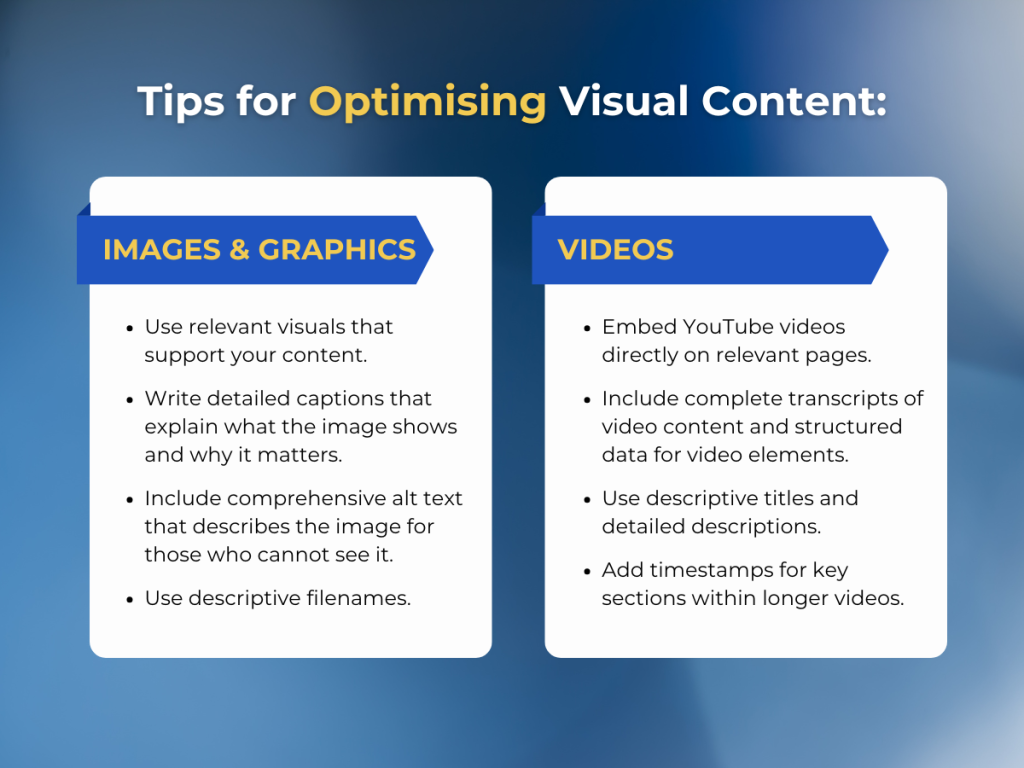
LinkedIn discovered that visual content, such as images, videos, and PDFs, acts as a strong signal for AI discovery when optimised correctly. Content optimised for AI dramatically increases visibility.
Content Freshness: Beyond Just Updating the Date
AI chatbots prioritise recent, updated information. But they can tell the difference between genuinely refreshed content and lazy date changes.
How to Genuinely Refresh Content:
- Update statistics with the most recent data available.
- Add new examples reflecting current industry developments.
- Remove outdated information that no longer applies.
- Incorporate new insights or methodologies developed since the original publication.
- Only then update the publication date.
Preparing for AI Agents: The Next Evolution
LinkedIn’s guidance addresses not just current AI chatbots but the emerging reality of AI agents, automated tools that browse websites and complete tasks without human supervision.
Whilst humans appreciate visual design and creative layouts, AI agents prioritise clear structure, solid data, and straightforward navigation.
Optimising now for AI chatbots future-proofs your content for the next wave of AI-powered discovery.
The Golden Nugget?
LinkedIn’s guide is comprehensive and valuable, but here is what they cannot say outright: the biggest advantage they have is not just technical optimisation, it is credibility and presence.
LinkedIn has millions of professional contributors from diverse sectors sharing genuine expertise. AI systems trust LinkedIn because real professionals with verifiable credentials publish there.
Perfect technical optimisation cannot overcome thin content from anonymous authors with no demonstrated expertise.
AI chatbots look for signals of authority:
- Author credentials and track record.
- Original research and first-hand experience.
- Citations from other credible sources.
- Evidence of genuine expertise in the subject matter.
- Consistent, long-term publishing on relevant topics.
LinkedIn’s technical optimisations work because they amplify already-credible content.
If your content lacks substance, expertise, and authority, no amount of schema markup will make AI chatbots cite it.
The Bottom Line: Traditional SEO Is Not Enough Anymore
Small businesses and brands cannot afford to lose the pipeline before it even begins.
When potential customers ask AI chatbots for recommendations, and your competitors appear in the answer whilst you do not, the sale is already lost.
Traditional SEO is not dead, but it is no longer sufficient on its own.
You need content that traditional search engines can rank and that AI systems trust enough to cite.
The businesses that crack this code now gain a competitive advantage before this becomes standard practice.
Need Help Optimising Your Content for AI Chatbots?
At Click Marketing, we help small businesses and brands adapt their content with tailored LinkedIn Advertising strategies for the ever-evolving discovery landscape.
From technical optimisation to building genuine expertise and authority, we implement proven strategies that get your content cited by AI systems.
Ready to show up in AI-generated answers? Let’s talk strategy.